The Tree of Life
What Tree Are You Eating From?
From the opening pages of Scripture, we are confronted with a question that is far more personal than it first appears (Genesis 2:9). It is not merely a question about history or theology, but about source, dependence, and the way we live our lives right now. In the garden, humanity was not surrounded by countless options. At the center stood two trees, and ever since, humanity has been living out the consequences of that choice. So the question remains just as relevant today as it was then: no
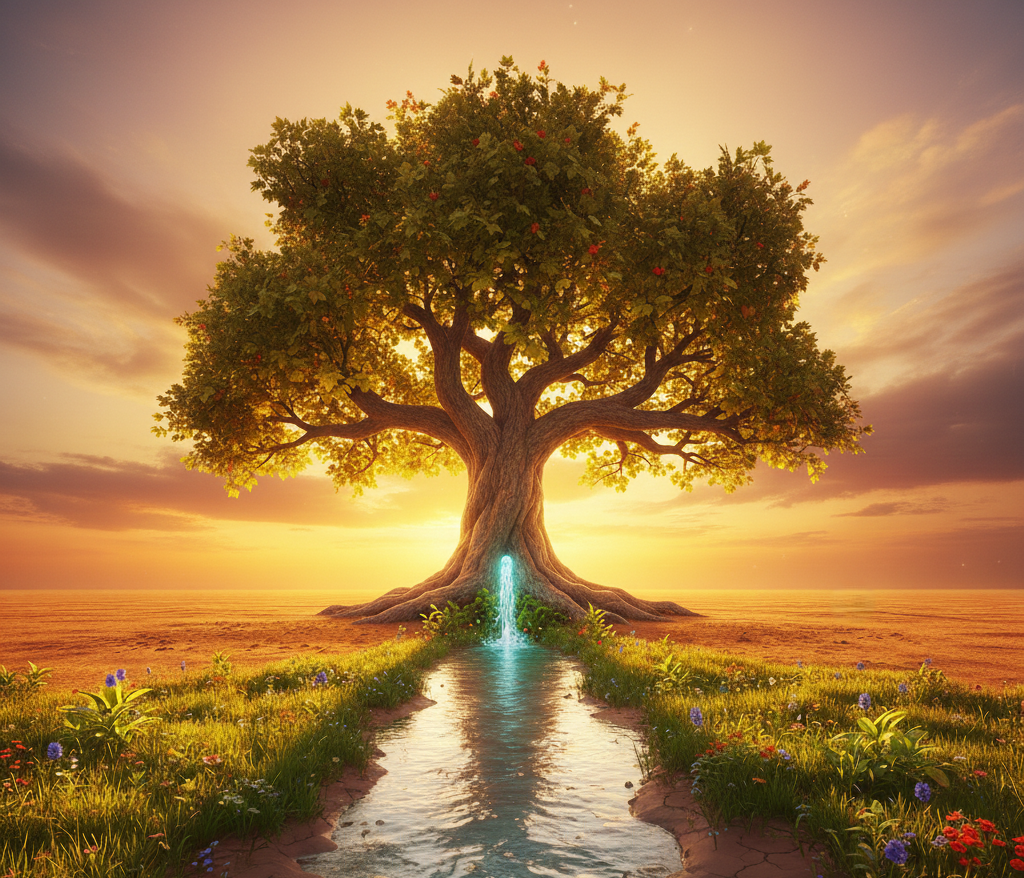
The Tree of Life appears at the very beginning of the biblical story (Genesis 2:9). It is planted by God Himself and placed intentionally in the center of the garden. It represents divine life, unbroken fellowship with God, and humanity’s intended way of existing in the world. To eat from the Tree of Life was to live continually from God’s presence. Life was not something Adam had to analyze, manage, or define. It was something he received. As long as humanity lived from this tree, life flowed naturally through trust, rest, and communion.
Alongside it stood another tree, the Tree of the Knowledge of Good and Evil (Genesis 2:9, 2:17). This tree represents something very specific and very subtle. It represents humanity choosing to determine for itself what is right and wrong according to its own wisdom, logic, reasoning, and perspective. Eating from this tree meant deciding morality independently from God. It meant becoming the judge, the evaluator, the one who defines good and evil. The issue was not merely rule breaking, it was independence. Humanity was no longer content to trust God as the source of life and truth, it wanted to become its own source.
When humanity chose the Tree of Knowledge, the shift was immediate (Genesis 3:6–7). Life moved from reliance on God’s voice to reliance on human discernment. From living by what God declared good to living by what seemed right in human eyes. Knowledge replaced trust. Self judgment replaced communion. Humanity did not stop believing in God, but it stopped living from Him as the source of life. God became someone to reference rather than someone to rely on.
The consequences followed quickly (Genesis 3:7–10). Shame entered the human experience. Fear followed close behind. Hiding became instinctive. When we eat from the Tree of Knowledge, we become self conscious, self measuring, and self protecting. We begin to evaluate ourselves constantly, and we extend that same evaluation to others. Right and wrong are no longer revealed through relationship, but enforced through performance. Life becomes something to get right instead of something to receive.
Access to the Tree of Life was then barred, not as punishment, but as protection (Genesis 3:22–24). Eternal life lived from self rule would be eternal separation. God’s response was not cruelty, but mercy. Humanity could not live forever from a fractured source. Yet even in this separation, God’s desire to restore life never disappeared.
Throughout Scripture, the Tree of Life quietly returns, not always as a literal tree, but as a way of living (Proverbs 3:18; 11:30; 15:4; Psalm 1:1–3; Jeremiah 17:7–8). In the wisdom literature, especially Proverbs, the Tree of Life becomes a metaphor for wisdom, righteousness, and healing. Wisdom is called a Tree of Life. The fruit of the righteous is called a Tree of Life. Even a tongue that brings healing is described as a Tree of Life. The message is clear, those who live by God’s wisdom, God’s righteousness, and God’s Spirit begin to embody the life that was once lost in Eden.
This reveals the true contrast between the two trees (Romans 7:10–11; Colossians 2:20–23). The Tree of Knowledge produces lives rooted in human logic, moral calculation, comparison, and self justification. It often leads to striving, anxiety, judgment, and exhaustion. The Tree of Knowledge is never satisfied, because knowledge alone cannot produce life, it can only inform behavior. The Tree of Life, by contrast, produces lives rooted in trust, rest, and transformation. Life flows not because we have perfectly figured out right and wrong, but because we are connected to the One who is love.
The Tree of Life operates by what God declares right and wrong, revealed by His Spirit, who moves toward us from unconditional love (Romans 8:2, 14; Galatians 5:18). This distinction is crucial. Decisions made from the Tree of Life are not fear driven, they are love motivated. Obedience is not an attempt to secure life, it is the natural response of those who already possess it. Righteousness is not self produced, it is fruit. Transformation happens not through pressure, but through presence.
Ancient cultures surrounding Israel also spoke of sacred trees, symbols of life, fertility, and cosmic order. Yet Scripture draws a decisive line between those stories and God’s revelation. In the Bible, the Tree of Life is never something humans climb toward, master, or control, it is always something God provides. Life is not achieved through wisdom, discipline, or moral effort. It is received through faith, trust, and reliance. Religion, in its most natural form, trains people to live from the Tree of Knowledge, constantly analyzing, measuring, and striving to get it right. It produces what I often call an “I do” religion, built on the belief that I do the performing and I am in control.
The gospel, however, restores us back to the Tree of Life, where life flows not because we ascended, but because God descended. That’s why I’ve often said there are really only two religions in the world, (two trees.) One is the “I do” religion, the other is the “He did” religion. The “I do” religion says, I strive, I ascend, I control, I decide. This is all the religions of the world summed up in two words. The “He did” religion says, He descended, He finished the work, He conquered, and He alone controls and decides. One places the weight of life on human effort, the other rests life entirely in divine grace. One keeps us striving from the Tree of Knowledge, the other invites us to live freely from the Tree of Life.
The final book of the Bible brings the story full circle (Revelation 2:7; 22:2; 22:14–15). The Tree of Life appears again, no longer guarded and no longer restricted. It stands openly in the midst of the New Jerusalem, bearing fruit continually, its leaves bringing healing to the nations. Scripture also makes a sobering distinction. Outside the city are those described as dogs, sorcerers, the sexually immoral, murderers, idolaters, and all who love and practice falsehood. This is not merely a list of behaviors, but a picture of life lived outside the city, outside shared life, order, and communion. The gates represent access to the life of God, and the city reflects a people ordered by His presence. Those outside are not lacking information, they are living from a different source. What was lost through self rule is restored through relationship. Access is no longer forbidden, it is invited. Life is once again available to be received, not achieved, by those who choose to live within the life of the city rather than from independence outside its gates.
And this is where the question presses in personally.
What tree are you eating from? Are your decisions shaped primarily by logic or by love? By self wisdom or by the Spirit? When pressure comes, do you default to control and calculation, or to trust and abide in communion? When people encounter you, do they experience evaluation or embrace, burden or nourishment, information or life?
The Tree of Life is not merely a distant symbol of heaven someday. Throughout Scripture, God consistently reveals that people themselves are trees, living beings who are planted, rooted, nourished, and sustained by a source outside themselves. This is not a poetic side theme, but a foundational biblical way of understanding human life in God.
Psalm 1 opens this truth with unmistakable clarity. The blessed person is not defined first by effort or achievement, but by delight, by a heart oriented toward the law of the Lord and meditating on it day and night. That person is like a tree planted by streams of water, yielding fruit in season, whose leaf does not wither, and who prospers in all they do (Psalm 1:1–3). The emphasis is not on striving, but on placement. The tree does not plant itself, it is planted. Its fruitfulness is not forced, it is the natural result of proximity to a life giving source. What the tree becomes is the inevitable outcome of where it has been placed.
This principle reaches back to the beginning. Genesis tells us that the LORD God planted a garden in Eden, and there He placed the man. Human life begins not with self determination, but with divine planting. God establishes the environment of life and places humanity within it (Genesis 2:8).
The Psalms return to this imagery repeatedly. The righteous flourish like the palm tree and grow like a cedar in Lebanon because they are planted in the house of the LORD. Their strength, longevity, and fruitfulness flow from where they are rooted, not from self generated power (Psalm 92:12–13). Proverbs echoes this truth, declaring that the root of the righteous will not be moved and that the fruit of the righteous is a Tree of Life (Proverbs 11:30; 12:3). Righteousness produces life not through moral force, but through living connection.
Isaiah makes the metaphor unmistakable. God’s redeemed people will be called oaks of righteousness, the planting of the LORD, that He may be glorified (Isaiah 61:3; 60:21). They are not merely like trees, they are God’s planting. Their existence displays His glory, just as a strong, fruitful tree displays the wisdom of the gardener who planted it.
Jeremiah reinforces this truth through vivid contrast. He places side by side two kinds of lives, one that trusts in man and one that trusts in the LORD. The one who trusts in the LORD is like a tree planted by water, sending out its roots by the stream. When heat comes, it does not fear. In drought, it does not panic. Its leaves remain green, and it never ceases to bear fruit (Jeremiah 17:7–8). The issue is not discipline or moral strain, but source.
The prophets expand this image beyond individuals to God’s people as a whole. God promises, I will plant them and not pluck them up. Again, I will plant them on their land, and they shall never again be uprooted. Even the coming Messiah is pictured as a tender shoot planted by God Himself, destined to grow, bear fruit, and shelter many. God is consistently revealed as the One who plants, preserves, and causes growth (Jeremiah 24:6; Ezekiel 17:22–23; Amos 9:15).
The New Testament does not abandon this imagery, it deepens it. Jesus declares that every plant the Father has not planted will be rooted up, implying that true spiritual life is something the Father actively establishes. Paul describes gentile believers as wild olive shoots grafted in, not self grown, but intentionally joined to a living root that God planted millenia ago. Jesus then brings the image to its fullest expression, I am the true vine, and you are the branches. Life flows from union, not effort. Fruit comes from abiding, not striving (Matthew 15:13; Romans 11:17–18; John 15:1–6).
Even transformation follows this same pattern. James speaks of the implanted word, not merely heard, but planted within, able to save the soul. Paul confirms that while people may plant or water, God alone gives the increase. Growth is never self produced, it is always God given (James 1:21; 1 Corinthians 3:6–7).
Taken together, the testimony of Scripture is overwhelming. People are described as trees. God is revealed as the planter. Fruitfulness flows from placement. Stability comes from rootedness. Life comes from connection to a source beyond ourselves. The Tree of Life, then, is not merely something we hope to encounter someday, it is a reality God is already forming in His people. We flourish not because we strive harder, but because we are planted by the Lord, rooted in His presence, and nourished by His life.
Together, these passages reveal a consistent biblical truth: humanity was always designed to live as planted people, rooted in God, nourished by His presence, and bearing fruit through connection. The Tree of Life is not only a future promise, it is a present reality for those who live from God as their source. Carrying spiritual language is easy. Choosing where we are rooted is where everything changes.
This is not an accusation.
It is an invitation.
An invitation to step out of self judgment.
An invitation to return to trust.
An invitation to live again from His very life.
So the question remains, quietly but persistently, shaping every choice we make and every way we relate to God and others:
From what tree do you derive your existence?